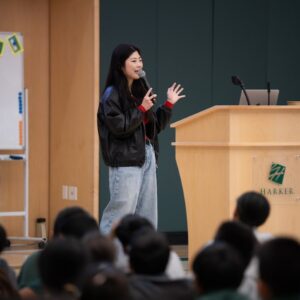
Last month, in recognition of National Coming Out Day, Harker welcomed author and educator Alex Myers to speak at a special assembly. Myers, who in 1995 became the first openly transgender student in the history of Phillips Exeter Academy, shared his journey of discovering his identity as well as the challenges faced by gender non-conforming people across the 20th century and into the present day.
“I believe there’s no more powerful force in the universe than the ability to tell a story, particularly your own story,” Myers began, “to learn the words that make you who you are, to be able to narrate your own story to other people.”
Junior Aiden Young, co-president of Harker’s Transgender Affinity Group (TAG), found it affirming to hear Myers tell his own story: “It was surreal and incredible to see someone like me live life as his true self. His visit gave me a little more hope for the future, and some lovely writing advice. I would love it if Harker had similar visits in the future, so students like me can see that they have a future, and that things just might be okay.”
Displaying photos of his early childhood, Myers related how he struggled with his identity throughout his life while adopting the gender markers of what was typically deemed female. At age four, he attended a friend’s birthday party wearing a dress and long hair, and was asked by an adult what he would like to be when he grew up. When he answered that he would like to be a boy, he was told that was impossible.
“I was like, hang on a second,” he said. “You asked me a question, and I gave you an answer. That’s what I wanted to be.”
In the 1980s, Myers found a mode of gender expression he was comfortable with in the tomboy (remarking along the way that other dynamics likely made his choice to appear more like a boy more acceptable than if a boy wanted to appear more feminine), but encountered resistance when he approached adolescence. “The closer I got to adolescence, the more the adults around me were saying, ‘It’s not cute anymore that you want to be a boy. It’s time for you to be a young woman,’” he said.
Diane Main, [title], found a sense of commonality with Myers in her own choices of gender expression. “I’m not trans, but I am gender non-conforming,” she said, “so it just felt really validating to have someone talk about what that experience was like and how for a long time it was OK to be however you wanted to be, but then you get to a point where start saying, ‘No, you need to be doing this. You need to be wearing makeup. You need to be having long hair.’”
Upon seeing Canadian singer k.d. lang for the first time, Myers lived as a lesbian during high school in the 90s, when gay and lesbian teenagers were becoming more comfortable living in the open. In 1995, he first learned about the concept of transgender, which was described to him as “being born as one gender, but having feelings towards or wanting to be another gender,” he said, following up with “Well, that sounds familiar.”
While admitting that labels can feel constrictive, Myers also said they “can also be transformative and freeing. They can allow you to say, ‘There’s a word for people like me, and that must mean I’m not alone,’” he said. Even though the term in 1995 was still many years away from being common, Myers said, “for me, transgender was home.” For Myers, it also relieved him of the pressure of having to undergo surgery, which was the expectation of people who were then called transsexual. “I just wanted to be treated as a boy.”
He started his senior year finally out in public as Alex Myers, facing some initial confusion from teachers and peers. “But they eventually said, ‘OK, if that’s how you feel, then you’re welcome.’” He faced mixed reactions from his parents, who described as “very loving, but also very upset.” One grandmother disowned him, while another “was incredibly proud of me.”
Upon entering Harvard, the second hallowed institution where he was the first openly transgender student, Myers decided he was finished pretending, “and made the decision that I wasn’t going to do this again. I wasn’t just going to try to blend in. I was going to let them know I’m here. This is who I am and this is how I want to live,” he said.
Following his morning talk, Myers sat down for discussions with Harker students and faculty. Patricia Burrows, Harker’s director of diversity, equity and inclusion, was impressed with Myers’ ability to engage audiences large and small. “His presentation was filled with images rather than words, and those images helped tell the story of his journey with clarity and nuance,” she said “In the classroom, he knew which questions to ask and how to build on students’ responses.”
Maggie Hu, grade 10, appreciated that Myers brough more awareness to the Harker community about the experiences of transgender people. “As a student journalist and Student Diversity Coalition officer, I’m always happy to see Harker inviting diverse voices and perspectives,” she said, noting his casual demeanor when discussing a topic that has become contentious due to trans people being made into targets of bigotry by segments of the media and prominent political figures. “I think it made a lot of students more aware of what transgender people go through and that at the end of the day they are also humans, especially since they’re becoming a hot topic in politics currently.”