This story originally appeared in the Spring/Summer 2026 issue of Harker Magazine, which can be read and downloaded from Harker’s issuu page.
Words by Dave Kiefer
Photographs by Sophie Ormond and Branden Keller, and provided by Harker Archives
The opening of Elizabeth Zhang’s book, “Vinnie’s Tour of the Universe,” reads like a sweet memory from her own childhood: “Sometimes when the moon is high, I open my window and look at the stars.”
For Zhang, grade 11, the origins of her interest in astronomy not only inspired her to write a children’s book, but evolved into a passion for astrophysics and the possible discovery of two exoplanets orbiting binary stars.
Those interests were cultivated at Harker, where asking questions and seeking answers is encouraged and emboldened, especially in the scientific realm, where Harker is among the nation’s premier high schools for research.
Zhang, whose first exposure to research came through Harker’s science research program in eighth grade, collected open-source data from the Kepler Space Telescope, trained a computer to look for patterns, analyzed them and found evidence of transits of circumbinary planets.
“One specifically had a very distinct sinusoidal signal,” Zhang said. “I looked through all the values. It’s good, it converges, and there’s a normal distribution, so I know what I’m looking at isn’t false or wrong. OK! This is good!”
Zhang, part of Harker’s Advanced Research Methods class, still needs to confirm her discovery and publish her findings, but somewhere out there are potentially two hidden planets discovered by a Harker junior.
A Regeneron International Science and Engineering Fair qualifier, Zhang adds to Harker’s significant research legacy.
Every year since 2006, Harker students have been recognized in the Regeneron Science Talent Search — the nation’s oldest and most prestigious science research competition for high school seniors. That’s 123 scholars/semifinalists of only 300 recognized across the nation each year, 22 finalists (top 40), and three winners (top 10) in 21 years.
Yi Sun earned second place in 2006 with new discoveries about a mathematical theory known as random walks. Andrew Jin was among three first-place winners in 2015 for developing a machine learning algorithm to identify adaptive mutations across the human genome. And Michelle Wei was third in 2024 for studying the mathematics of second-order cone programming and finding that these problems can be solved more quickly than previously thought by converting the original problem into a modified form.
In the Siemens Competition, held from 1999-2017, Harker had 21 regional finalists and seven national finalists, making Harker fourth on the list of schools with the most national finalists in the competition’s history.
Harker’s research interest “doesn’t really surprise me,” said Research Methods teacher Sam Lederer. “Harker is a place that’s known for its scientific prowess and provides the kind of resources and lab space for students to do this kind of work.”
Or, as Honors Advanced Research teacher Mike Pistacchi puts it, “They’ve got the work ethic. They’ve got the education. And they’ve got the drive to figure it out.”
Science is introduced early at Harker. The Women in STEM (WiSTEM) club annually visits and conducts experiments in TK, kindergarten and first-grade classrooms. Earth science is introduced in third grade, physics in fourth, and biology in fifth. Those subjects are covered deeper in middle school, with chemistry joining the mix.
In eighth grade, students are paired with faculty mentors for research projects showcased at Santa Clara County’s Synopsys Science Fair.
“The foundation of our research is this really deep science program that we have,” said Jennifer Gargano, assistant head of school for academic affairs. “Because you can’t research if you don’t understand science.”
At the upper school, research is taught at three levels, with an eye toward the Regeneron talent search. There also is a research club, an open lab for independent projects, and clubs such as WiSTEM, which promotes research and helps science chair Anita Chetty organize the annual Harker Research Symposium.
The original vision came from Diana Nichols, head of school during Harker’s transition from K-8 to K-12 in the late 1990s.
“The school was very much about establishing itself as Silicon Valley’s high school,” said Chetty, who arrived as an AP Biology teacher in 2001. “She wanted the school’s name to be recognized for excellence at the national level.”
The vehicle was national competitions. With the help of physics teacher Dan Mathews, who embraced the research ethos, the program took off and Nichols’ objectives were fulfilled in 2006 with Yi Sun’s second place in the Intel (now Regeneron) STS and Christopher Sutardja’s Siemens regional semifinal honor.
“It suddenly put our school on the national stage,” Chetty said.
While honors were worthy of celebration, Chetty did not want contests to be the driver in Harker research.
“I was not interested in the competition,” Chetty said. “I wanted the students to learn how to do research. That was my goal.”
The result was the Harker Research Symposium, created in 2006 to get the Harker community excited about research and to show students what excellent research looks like.
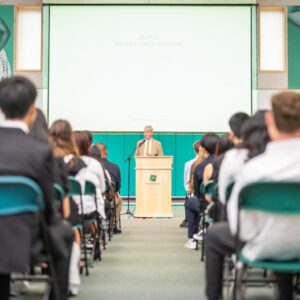
The first symposium had 35 registrants and was held in what is now the auxiliary gym. Twenty years later, more than 600 attended the event, with keynote speakers, alumni and student panels, and poster sessions. Now, the gleaming Patil Theater and the state-of- the art Nichols Hall science building are the backdrops, and high-end equipment such as a DNA gene sequencer, “that you wouldn’t typically find outside of a university lab,” Pistacchi said, are donated and at the students’ disposal.
“I had no clue I would go into medicine,” said Rebecca Yanovsky Dufner ’09, director of health and clinical innovation at Tufts Medical Center and this year’s symposium alum keynote speaker. “I didn’t have any exposure to medicine. But Harker gave me the tools to be able to do whatever I wanted. I could learn new things. I could go to people for help. I could find mentors. I felt like people believed in me and I felt that I could do anything. It laid that foundation for me to go and really achieve it.”
A member of this year’s symposium alumni panel, Akshay Jagadeesh ’12, a research scientist working at the intersection of artificial intelligence and neuroscience, said, “One thing Harker totally unlocked for me is that feeling of being excited about, and not being afraid, of something new. That’s been the most empowering thing for my career, that feeling of, I can learn new things, I can pick up new skills. I have the fundamentals that allow me to absorb and take on new challenges.
“That came from being in this environment where we were constantly getting exposed to new things.”
Research and bioinformatics teacher Terese Navarra did not have access to this kind of education or resources at her Nebraska high school when she was growing up. Her first exposure came in college, an experience she found “life-changing.”
Looking back, Navarra would have preferred to discover research earlier, and that’s where Harker has an advantage.
“High school students don’t have to wait for somebody to say it’s OK,” Navarra said. “I want them to see that they can have a profound impact within the science realm by starting now. It’s empowerment and giving the students the ability to know they can change things. And you can do it here at Harker.”
Or, as Gargano said. “This is your time to dream big.”
When WiSTEM co-president Anika Basu, grade 11, was younger, she experienced a disturbing incident in which one of her best friends was cyberbullied. Basu recalls trying to comfort her friend, who couldn’t stop crying.
In response, Basu found herself researching online abuse and the psychology of why people bully others. She grew interested in the computer science and neuroscience aspects of the domain of hate speech and sought to develop tools that could prevent it.
During a summer research program at UC Santa Barbara, Basu expanded her research with a project titled, “Analyzing Hate Speech Amplification on Fringe Platforms.” Her goal was to create efficient machine learning algorithm models that could detect and remove hate speech. There also is a security aspect, preventing crimes before they happen. And, finally, Basu explored the best possible responses to mitigate hate speech and to inform effective counterspeech.
“I always wanted to be a computer scientist,” Basu said. “But now I have a clear purpose. That moment when my friend sat next to me was my north star. It keeps me going on long nights when it’s 2 a.m. and my code isn’t working. This is what I’m doing it for.”
Senior Linda Zeng’s research project “Bringing up BabyLM: Investigating Multilingual Language Acquisition Using Small-Scale Models,” combined her interests of language, developmental psychology and AI. She’s worked on the project, exploring how babies learn different languages and become bilingual, with Stanford children’s language learning expert Michael Frank and will continue to do so as a Stanford undergraduate next fall.
When she arrived at the upper school, Zeng felt that even with Harker’s robust research opportunities, there were some holes. So, she helped expand the role of Harker’s creative research club by creating monthly workshops on topics such as abstracts, presentations and writing. She created a database of past Harker research works, and a mentorship program that pairs older students with ninth and tenth graders, to guide them through the research process.
“The most productive way to look at research is to find your interests and really go deep into them,” Zeng said. “I’ve never felt like I’ve had a shortage of time to do what I’m actually truly interested in.”
Regeneron scholar Evan Zhang, grade 12, explored “Self-SensingHydraulically Amplified Self-Healing Electrostatic Artificial Muscles With AI-Driven Control for Cardiac Assist.” With interests in mechanical engineering and soft robotics, Zhang, using 3D printing, created and tested a device that squeezes the aorta to improve blood flow for those with heart issues. The device uses soft materials like silicone and fabrics, which are more compliant and adaptable to the human body than hard- surfaced instruments.
“I love working with my hands and making these small devices,” he said. “And, more broadly, I can actually make a real-world impact.”
He remembers the moment it all came together. It was in the summer, in a lab at Purdue University.
“It was actually on my birthday,” Zhang said. “It was 6 p.m. I had built three of the same versions that day and they hadn’t worked. So, I kept tweaking things. On the very last one, it actually worked. It was super magical for me. Actually seeing it work was probably the most satisfying breakthrough of this whole process.”
Saria Lum, grade 10, was nervous as the judges approached her exhibit at Synopsys. Lum’s project was especially meaningful because of her personal difficulties with eczema and her desire to find a solution. The result was PatchPal, a product she developed with use of a spectrophotometer to find the right combination of corticosteroids to help reduce flareups and prevent future ones.
“I was scared I was going to make a fool of myself for the judges,” said Lum, and her fears seemed realized when the first judge did not engage in her pitch. So, Lum changed her approach. Instead of a rehearsed script, she chose to be more spontaneous, speaking from the heart and projecting confidence with the work she had done. Suddenly, the judges were fully attentive.
“It’s honestly all owed to Harker,” Lum said. “They really teach you from a young age to be curious. I’ve never had a teacher tell me, ‘That’s too ambitious.’ They always encourage you go even deeper: What can I do in the future?”
In Elizabeth Zhang’s book, the main character, Vinnie, returns from a galactic adventure guided by a magical jellyfish named Luna. After learning about galaxies, light waves, supernovas and even black holes, Vinnie settles on her lawn in time to witness a meteor shower.
“It’s beautiful,” she said.
And like that magical mystical night, for Zhang and other Harker researchers, the future holds so many possibilities.
Dave Kiefer is a freelance writer and former journalist with the San Jose Mercury News.