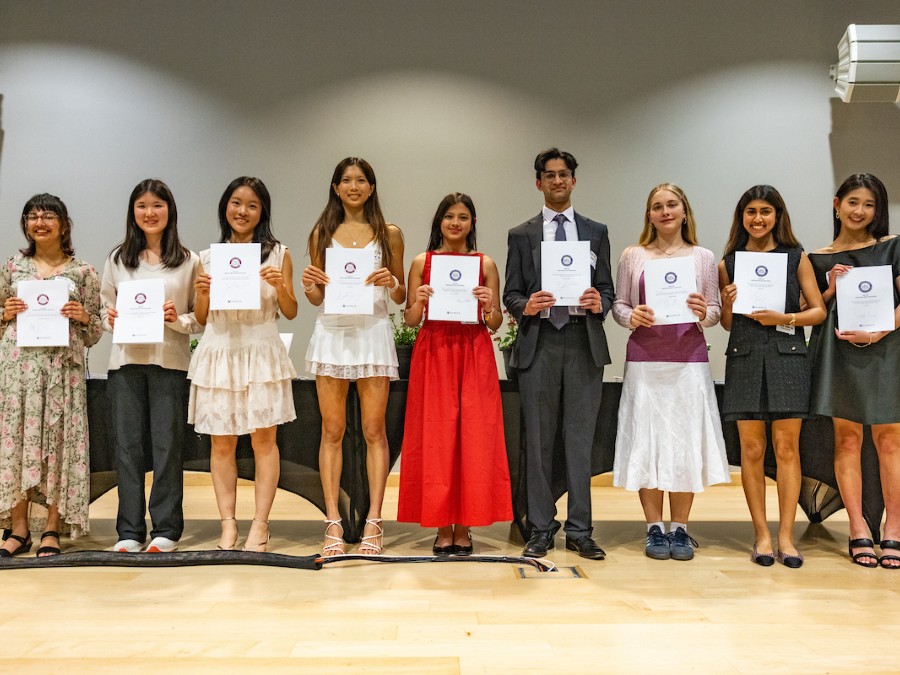
On Apr. 28, the 2026 Near-Mitra scholars were joined by their families, friends and mentors for the annual scholar recognition event, which featured talks by Near Scholars Natalie Barth, Farhan Ansari, Sofia Shah, Ananya Pradhan and Yena Yu; and Mitra family scholars Linda Zeng, Joy Hu, Anoushka Chakravarty and Ariel Zheng. Each senior scholar gave summaries of the topics of their research and what they learned during the process, and offered thanks to the faculty members, supported by the Chen Lin Family Endowment, who contributed their guidance. All of this year’s Near-Mitra projects are published on Harker’s issuu site.
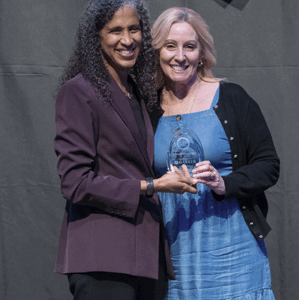
The event began with a brief introduction by history teacher and Near-Mitra program director Donna Gilbert, Olivia Zhu ’11, one of the first Near scholars, made a special appearance via Zoom as the first to receive the Legacy Scholar award. Zhu, who went on to become a federal prosecutor, discussed her experience as a Near scholar and its impact on her both personally and professionally. “[T]hose critical research skills were essential to my ability to do my job,” she said. I was constantly having to evaluate the strength of documents and videos and photographs and evidence. I got to travel all around the country and the world, from South Dakota to Estonia, interviewing witnesses, hearing their stories, making sense of what they were saying and using all those sources to put together a case, much in the same way that many of you have put together your own research projects.”
First to present was Natalie Barth, whose project explored the decline in popularity of romantic comedy films as streaming platforms have gained more prominence. “Because of [these platforms’] large output, they generally undermine the film’s quality,” she said. “I note that rom-coms, in particular, heavily rely on those compromised atmospheric elements to build a sense of charm and coziness that viewers call back to when discussing the genre.”
Farhan Ansari researched the connections between the 19th-century American expansionist idea of Manifest Destiny and the expansionist goal of Lebensraum espoused by the Nazis. “Though I was initially hesitant to explore this topic, given its controversial nature, I felt compelled to better understand the history and the consequences of colonialism and imperialism,” Ansari said. “Over time, that hesitation gave way to curiosity.”
Sofia Shah’s project examined the failure of western military operations in Afghanistan, in particular the ostensible feminist goals that were used to justify them. “Across the world, images of burkas are seen as oppressive. In France, for example, bans on veils, face coverings and hijabs infiltrate public spaces and even schools. But why then does that necessitate US troops and military operations to enter Afghanistan?” she asked.
For her project on the precipitous fall in the number of women studying and working in computer science in the 1980s, Ananya Pradhan analyzed information such as perceptions in media of women in the field and how companies hired for positions. “And second, because accounts encompassing an entire discipline lack specificity at the level of the individual, I wanted to elucidate specifically the lived realities of women in this field,” Pradhan said.
View this post on Instagram
Yena Yu investigated the history of redlining (the practiced of denying financial services to areas occupied by significant numbers of marginalized people) and its role in worsening the effects of the 2008 financial crisis. “I mainly studied the effects of these practices from 1999 to 2008, exploring how the explicitly racist language of the appraiser’s underwriting manual…contributed to the under-appraisal of property in Black neighborhoods,” she summariazed.
The first of the Mitra family scholars to present, Linda Zeng discussed her project’s deep dive into the Chinese immigrant population of Mexicali (driven south from California by the 1882 Chinese Exclusion Act) and their influence on the culture, economy and politics of the region. “[T]he border doesn’t simply divide people, but it creates a system where survival is based on navigating more than one part of yourself and often having to commit vice, like smuggling and gambling, in order to survive in an area that’s inherently precarious,” Zeng noted.
After seeing Algerian athletes throw rose petals into the Seine River during the 2024 Summer Olympics, Joy Hu learned that this gesture was in remembrance of the 1961 Paris Massacre, during which French-Algerian protestors were drowned in the Seine. Her project focused on the repression of information about the incident, which she said “had a counterproductive effect, because as this information gradually decided to surface across the national psyche in France…it ended up worsening social divisions in France.”
Anoushka Chakravarty explored the history and output of Amar Chitra Katha, an Indian comic book publisher founded in 1967 that specializes in stories based on Indian mythology and folk tales, connecting ACK to the growth of Hindu nationalism across the country. “In my paper, I evaluate various comics of Amar Chitra Katha and their historical subjects in their alignment to Hindu nationalism, particularly in opposition to Islam and Muslims,” she said.
Finally, Ariel Zhang spoke about the subject of her paper, an exploration of the performance of gender in Virginia Woolf’s “Orlando: A Biography,” in which the central character, who does not perceptibly age, changes genders after living for 100 years. “My research focuses on how gender is not a biological essence, but rather a social performance that we put on through our speech, behaviors, and clothing,” she said.