By David Kiefer
In 20 years, the Harker Research Symposium has grown into an event that “epitomizes, on our best days, what we try and aspire to be.”
That statement, by Jennifer Gargano, assistant head of academic affairs, illustrates the way scientific research has become not just a source of pride for Harker, but a core of it as well. The Symposium expresses that perfectly.
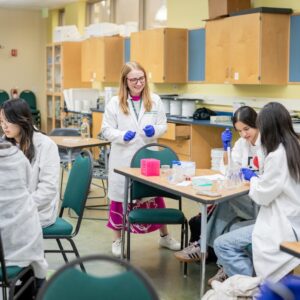
When upper school science department chair Anita Chetty dreamed up the first Symposium in 2006, “I wanted the kids to learn how to do research,” she said. “My focus was not on competition. I was more interested in, let’s make as many of them into good scientific thinkers.”
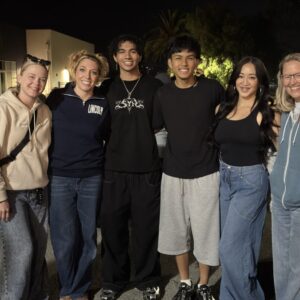
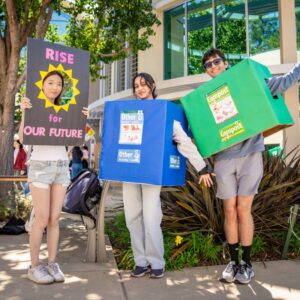
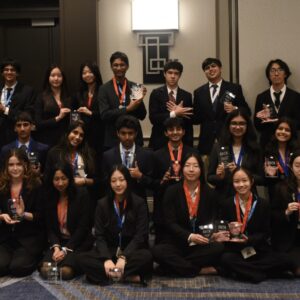
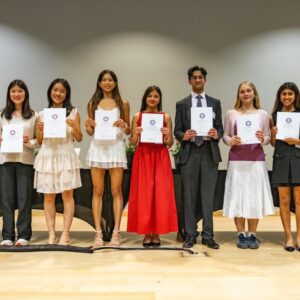
The first Symposium in what is now the auxiliary gym had 35 registered attendees. On Saturday, April 11, 2026, there were 660 and more than 100 students, parents, and faculty and staff in support, all organized by Harker’s Women in STEM.
It’s a celebration of research, with student exhibitors and presentations, and keynote speakers who tried to unravel the theme of NextGen Medicine: Where Genomics, AI and Research Shape Tomorrow’s Heathcare.
Charles Taylor, head of the Center of Computational Medicine at University of Texas and a leader in AI, machine learning and digital twin technology, described his uses of technology to help diagnose coronary artery disease.
View this post on Instagram
“I’m excited about this big idea that if you walk into the hospital and check in at the front desk, your digital twin, your digital model, comes in with you,” he said. “That’s going to change medicine. That’s the foundation.”
WiSTEM co-president Linda Zeng delved deep into AI in her study of multilingual language acquisition in children and said, “Instead of being scared of AI, we can use models to help us learn more about ourselves.”
But doing so requires care.
“Think carefully about the problem we’re trying to solve, not just what technology can build or do,” said alumna Rebecca Yanovsky Dufner ’09, director of digital health and clinical innovation at Tufts Medical Center. “If you don’t understand the problem and its nuances, you probably will not come up with the right solution or put the solution in the right hands.”
Vinod Ravikumar ’08, assistant professor of neurology at New York Medical College, said many think medicine “can be broken into AI and doctors will be replaced by machines. But I think medicine is more of an art than a science. Every case is different, every patient is different, every solution is different. My patients count on me. It makes me feel a pride and joy, and the impact is tremendous.”
Patrick Lincoln, Defense Advanced Research Projects Agency office director, pushed the envelope further with his thoughts on longevity escape velocity – the theoretical point where scientific advancements add more than one year to human life expectancy for every year that passes, enabling indefinite lifespans.
“There are many diseases and frailties of the human body,” Lincoln said. “Are there things that will improve the human condition and get us to have a longer and healthier life? I’m a technology optimist and I believe it is possible for us, in the lifetime of Harker students today, to reach longevity escape velocity. The technology for biology and health care will grow that fast.”
Symposium preparation began in June and at the end of the rainy day, WiSTEM co-president Anika Basu barely had time to reflect before heading to her jazz band concert.
“Ms. Chetty lives by the philosophy, be overprepared, not underprepared,” she said. “That means a lot of coordination and a lot of work, and a lot of fun.”